

The Berlin real estate market will remain very lively in 2024, according to current figures from the Appraisal Committee for Property Values. In the second quarter of the year, significant changes became visible in various market segments. There were notable increases, particularly in building plots, condominiums and single-family homes, while the market for rental housing developed in a differentiated manner.
Building plots: Strong increase in sales despite slightly falling prices
In the building plots segment for single- and two-family homes, the number of plots sold rose by an impressive 71% in the second quarter of 2024 compared to the previous quarter. Sales in this area increased by 43%. Despite the strong increase in sales, the average price level fell slightly by 3%. This indicates that demand for land remains high, but pricing has eased slightly due to the market situation.
Multi-story residential construction: Decline in sales and turnover
The multi-story residential construction market recorded a significant decline in the second quarter. The number of plots sold fell by 32%, which also led to a 27% decline in turnover.
Single- and two-family houses: Stability with increasing turnover
A positive development was observed in the single- and two-family house sector. Sales figures rose by 16%, while turnover increased by 19%. Unlike building plots, the average price level remained stable, which shows that investors are still willing to buy at a constant price level. This strengthens confidence in the Berlin real estate market.
Condominiums: High demand for new buildings
The market for condominiums grew particularly strongly. The number of apartments sold rose by 22%, with new buildings being particularly in demand with an increase of 35%. Sales also rose significantly – by 22% for existing apartments and by 42% for new buildings. Prices remained relatively stable, with slight increases of 2% for existing apartments and 1% for new buildings.
Rental homes: Slight increase in sales while sales fell
Sales of rental homes rose slightly by 5%, while sales fell by 29%. This opposite development indicates that there is still interest in rental properties, but that financial transactions are on a smaller scale. This may be due to lower price expectations among buyers or a changed structure of the properties sold.
Offer and purchase prices: There is still room for negotiation
The difference between offer and purchase prices in Berlin is still large at -7.2%. In a nationwide comparison, this deviation is on average -8.3%, with Hamburg (-11.4%), Munich (-8.7%) and Frankfurt (-7.9%) showing particularly large differences. For buyers, this means that there is still room for negotiation. Brokers must increasingly use their brokerage skills to bring buyers and sellers together.
Construction financing: Highest level since 2022
In July 2024, the volume of private construction financing in Germany reached 19.5 billion euros, the highest level since July 2022. This corresponds to an increase of around 20% compared to the previous month and around 26% compared to the same month last year. This development is fuelled by stable construction interest rates, rising rents and growing demand for real estate. This trend is providing important impetus to the real estate industry, particularly in a city like Berlin, where demand is high and new construction activity is limited.
Conclusion: A dynamic and segmented market
The figures for the second quarter of 2024 show that the Berlin real estate market remains stable, but is developing in a highly segmented manner. While there is a decline in prices in some areas, such as building plots, there is increasing demand in other segments, especially for new buildings. Buyers still have room for negotiation, especially when it comes to the differences between asking and purchase prices. It is therefore essential for brokers and investors to closely monitor the trends in the various market segments in order to make informed decisions.
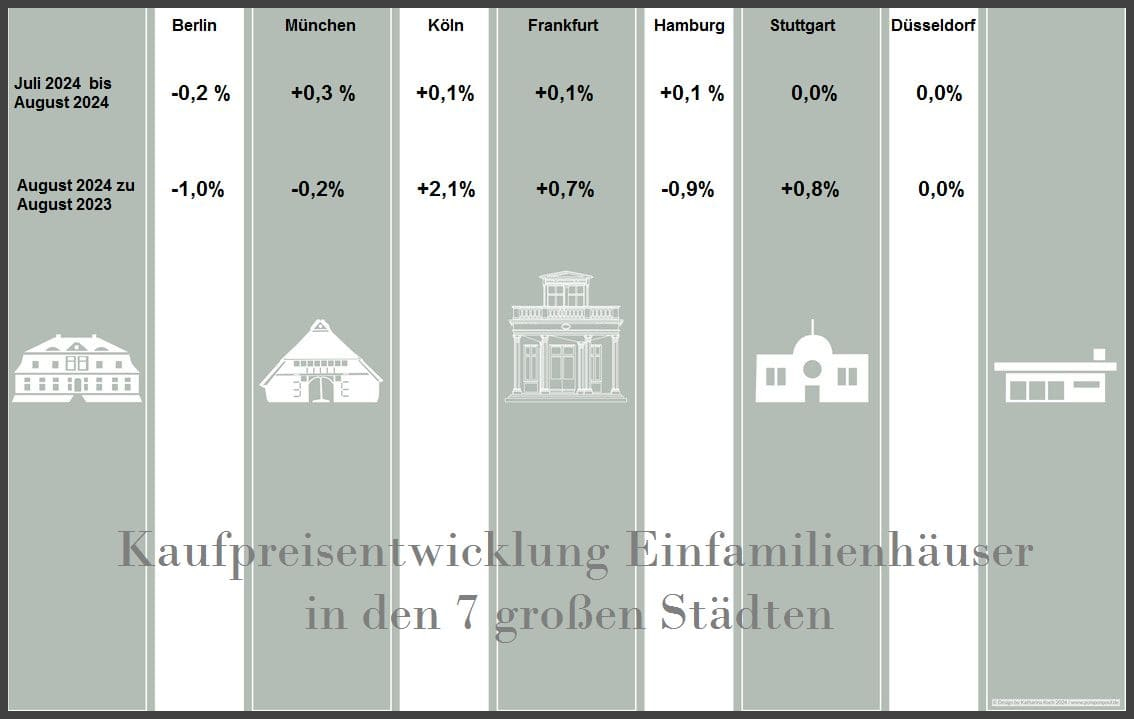
Comparison of the largest cities: purchase prices largely stable
The purchase prices in the seven largest cities in Germany (BIG 7) show a largely stable development with minimal fluctuations in recent months. However, slight declines can be seen year-on-year, particularly in Hamburg and Berlin. The accompanying graphic shows the percentage price changes for single-family homes from July to August 2024 compared to previous years.